
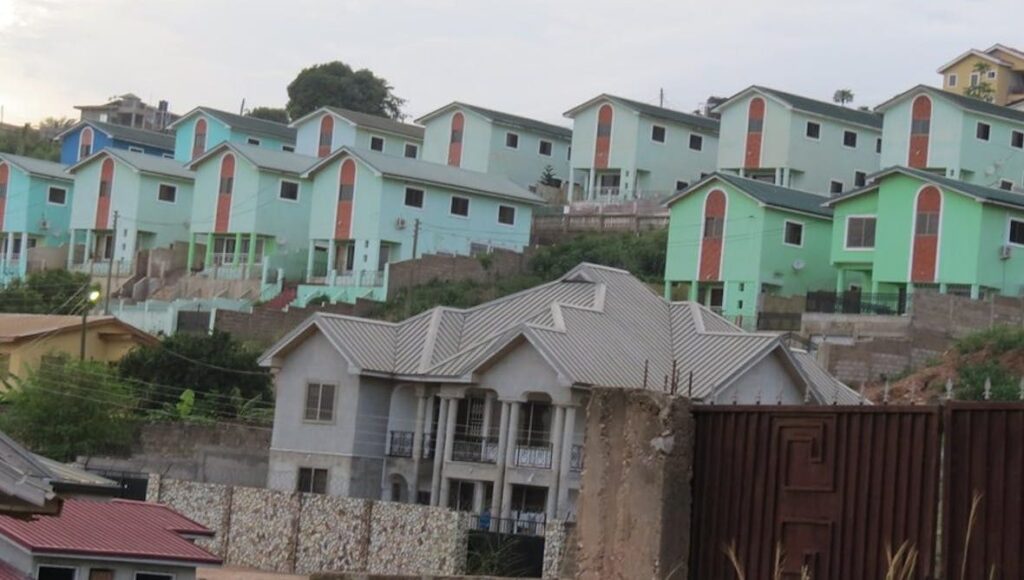
For many years, discussions about Ghana’s housing sector have centered on one widely cited statistic—a housing deficit estimated at approximately 1.8 million homes. While this figure highlights the country’s growing demand for housing, it tells only part of the story. A house may exist, yet still fail to provide safe, healthy, and adequate living conditions.
A recent study argues that addressing Ghana’s housing challenges requires looking beyond the number of homes needed to examine the quality of the homes people already occupy. Using data from Ghana’s 2021 Population and Housing Census, researchers assessed housing conditions for more than 836,000 households across all 261 districts, providing a comprehensive picture of housing adequacy nationwide.
Measuring Housing Quality
To evaluate housing conditions, the researchers developed a Multidimensional Housing Quality Index (MHQI). Rather than focusing solely on housing availability, the index measures whether households meet minimum standards across nine essential dimensions of housing.
These include structural durability, overcrowding, access to safe drinking water, electricity, toilet and bathing facilities, clean cooking fuel and cooking space, as well as waste disposal systems. Together, these indicators provide a broader understanding of whether homes are suitable for healthy and dignified living.
The national average housing quality score was 62.2 out of 100. Rather than representing a pass or fail mark, this score serves as a benchmark for comparing housing conditions across different geographical areas and population groups.
Wide Disparities Across Communities
One of the study’s most significant findings is the stark disparity between urban and rural housing conditions. Urban households recorded an average housing quality score of 73.1, compared to only 45.3 for rural households. This substantial gap reflects unequal access to basic infrastructure and essential services rather than differences in housing structures alone.
The study also found that 56.5% of households experience multidimensional housing poverty, meaning they face multiple housing-related deprivations simultaneously. More concerning, 37.2% of households were classified as severely housing poor because they experienced more intense and overlapping deficiencies. Importantly, these measures relate specifically to housing conditions and should not be interpreted as indicators of income poverty.
Progress Is Uneven Across Essential Services
The findings also reveal that improvements in one area of housing do not necessarily translate into overall housing adequacy. Access to electricity and safe drinking water is relatively widespread, with 86.2% and 82.4% of households respectively meeting minimum adequacy standards. However, other essential services remain far behind. Only 37.3% of households use clean cooking fuel, 42.9% have improved sanitation facilities, and just 33.4% use adequate waste disposal systems.
These results demonstrate that housing quality depends on multiple conditions working together. Reliable electricity cannot compensate for poor sanitation, while durable housing structures cannot offset the health risks associated with unsafe cooking fuels or inadequate waste management.
National Averages Mask Local Realities
Although regional differences remain evident, the study shows that district-level variations are equally important. Greater Accra recorded the country’s highest regional housing quality score, while the Savannah Region ranked lowest. However, researchers observed considerable variation among districts within the same region. Some districts in relatively well-performing regions still exhibited severe housing deprivation, while others in lower-performing regions performed comparatively better.
These findings suggest that relying solely on regional averages may overlook communities facing significant housing challenges. District-level evidence is therefore essential for designing interventions that respond to local needs.
Implications for Housing Policy
The researchers emphasize that the Multidimensional Housing Quality Index should complement not replace the traditional housing deficit estimate.
While the housing deficit identifies how many additional homes are required, the quality index identifies where existing homes fall short and which housing services require urgent attention. Different communities face different challenges, meaning that housing policies should be tailored to local circumstances rather than relying on uniform national solutions.
The study further recommends stronger coordination between the housing sector and related sectors such as sanitation, water, energy, waste management, local government, and spatial planning. Improving housing quality requires integrated investments that address multiple dimensions of living conditions simultaneously.
The researchers also propose developing district-level housing quality dashboards or atlases to help policymakers monitor progress, identify priority areas, and guide evidence-based investment decisions over time.
Key Takeaway
The study demonstrates that solving Ghana’s housing challenge requires moving beyond simply counting the number of houses that need to be built. Equal attention must be given to improving the quality, safety, and adequacy of existing homes. By incorporating multidimensional measures of housing quality into planning and policy, Ghana can develop more targeted interventions that improve living conditions, reduce inequalities, and ensure that housing is not only available but also fit for healthy and dignified living.
Source: Adapted from The Conversation article, “Ghana’s housing problem goes beyond numbers – it’s also about quality,” published on 4 August 2026.