Cheerful ethnic female cafeteria owner in apron demonstrating cardboard signboard while standing near blue shabby door and windows after starting own business and looking at camera

SOUTH AFRICA’S SMALL BUSINESS GROWTH INDEX

About the Small Business Growth index (SBGI)

The Small Business Growth Index, launched in February 2025 by Absa Bank, SACCI, and UNISA’s Bureau of Market Research (BMR), is South Africa’s first comprehensive measure of small business health. It focuses on enterprises with 50 or fewer employees, providing policymakers and business leaders evidence-based insights into the state of the sector. The SBGI was designed to track trends in key areas such as business confidence, revenue growth, employment creation, access to finance, and overall sustainability, thereby serving as a barometer for the vitality of the country’s small business ecosystem.

Growth

Resilience

Challenges

The inaugural survey, covering 1,601 businesses across all nine provinces, produced a score of 51.08 out of 100, placing the sector in the “vulnerable” category a reflection of rising costs, including access to financing, and fragile survival prospects. The following sections provide analytical insights into the findings and outline key policy recommendations.

The Role of SMEs in South Africa’s Economy

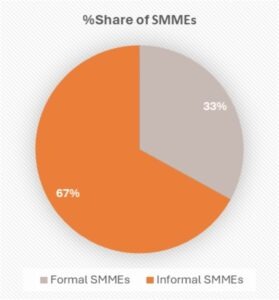
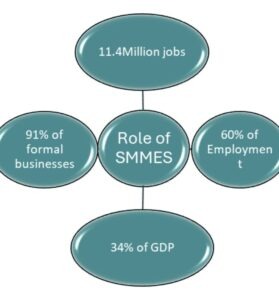
Small, medium, and micro-enterprises (SMMEs) (Figure 1) form the backbone of South Africa’s economy, driving employment, income generation, and overall economic growth. They are particularly critical in absorbing labor from the informal sector and providing local-level economic resilience. According to BMR data (Figure 2), SMMEs contribute significantly to GDP and employment, yet their growth remains constrained by persistent structural barriers.

While the sector’s contribution to the economy is notable, its fragility persists. Many firms operate on thin margins, face cash-flow challenges, and lack access to affordable financing, factors that limit scalability and innovation. This mixed picture underscores the urgent need for an enabling policy environment to support sustainable growth.

Figure 1: % Share of SMMEs in South Africa
Figure 2: Role of SMMEs

Survival Outlook

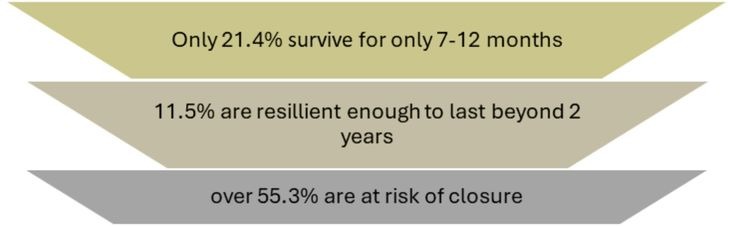
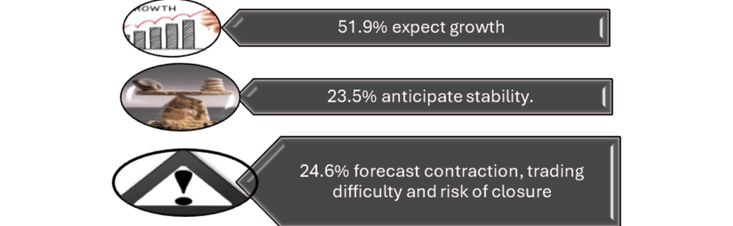
Despite its importance, the sector remains fragile — a reality made clear in the survival outlook derived from the SBGI (Figure 3). illustrated below: The findings depict a delicate balance between optimism and vulnerability. While many firms remain hopeful about future growth, a significant share continue to battle contraction, instability, and the persistent threat of closure.

Figure 3: Survival Outlook
Figure: 4

This duality reflects structural asymmetries in market access, resource distribution, and policy implementation. Firms located in urban centers tend to report higher resilience due to better access to finance and infrastructure, while rural enterprises face more pronounced challenges. Sustaining optimism in such an environment will require targeted interventions that strengthen both financial and operational resilience.

The inflationary squeeze on SMMEs

The inflationary environment continues to erode profitability, leaving many firms cash-strapped as shown by sharp cost increases across all major categories, with transport and fuel costs rising the most (Figure 5). Rising energy and logistics costs have had a multiplier effect, squeezing margins and reducing reinvestment capacity.

Inflation’s impact extends beyond immediate financial strain—it also undermines employment stability, supplier relationships, and investment confidence. Addressing these pressures requires coordinated macroeconomic and sectoral policy responses, including energy price stabilization and the expansion of financial support mechanisms for cost-sensitive microenterprises.

Figure 5: Cost Inflation During Past 6 months

Current Business Challenges

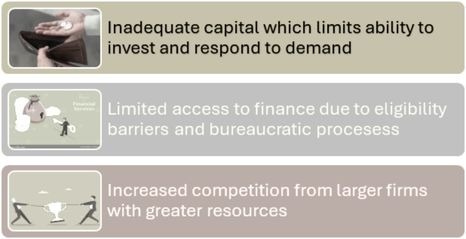
But rising costs are just one part of the story. South Africa’s small businesses continue to face deeper structural challenges that undermine their long-term resilience such as depicted in Figure 6:

Figure 6: Current SMMEs Challenges
Recommendations